
Digital Access With a Familiar User Experience
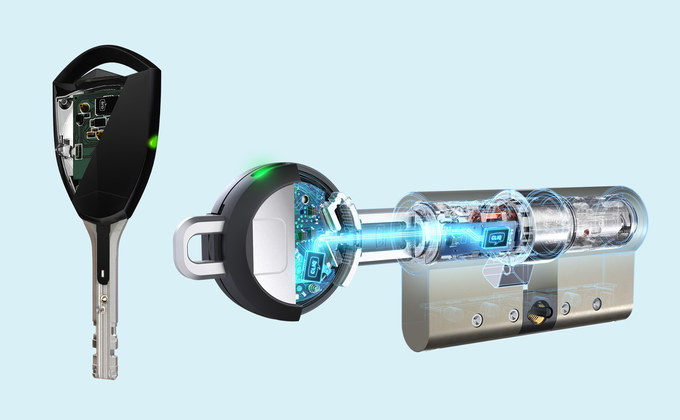
Digital access does not have to abandon the familiarity of a key. With programmable smart key systems, organizations can modernize access management gradually, improve control, and reduce disruption while keeping a user experience people already understand
By: Thomas Schulz, Director & Head of Marketing DAS EMEIA, ASSA ABLOY Opening Solutions EMEIA
E-mail: thomas.schulz@assaabloy.com
As businesses upscale, downsize, or onboard new locations, facility managers must manage access control ever more flexibly. Increased service contracting has also handed many essential functions over to third-party providers, rather than employees. They, too, need efficient building access that does not compromise security.
At the same time, physical, cyber and ‘hybrid’ physical-cyber threats loom large, as do the regulations designed to protect critical sectors from them: compliance and the implementation of joined-up security and access management are ongoing challenges, particularly in infrastructure, finance/banking, healthcare, energy, transport, and data centers.
Mechanical locking was not designed for the complex, dynamic nature of this ‘new normal’.
Combine the Advantages of Keys and Digital Management
One major benefit of the mechanical key is its familiarity. A mechanical locking system with patent protection may still be an appropriate solution. However, digitization offers many opportunities for business efficiency and compliance.
Unlike mechanical locking, a digital solution enables security managers to allocate time-based rather than blanket access authorization, and to amend it quickly and flexibly. A digital credential can be programmed or de-authorized in seconds, negating the threat and significant costs of lost mechanical keys. When building technology can connect digital solutions for access, fire protection, and escape routes both user safety and facilities management benefit. With a digital solution, audit capability is also automated, benefiting compliance efforts; manual access tracking with mechanical keys is either time-consuming or, in many cases, impossible.
Any new access or security solution must battle for budget and justify its total cost of ownership, producing a definable return on investment. Smart key systems are the fastest, least disruptive way to switch mechanical security for intelligent digital access.
“Of course, moving from mechanical to digital access management is not like flicking a switch,” says Frank Stier, VP & Head of PU Key-based Digital Cylinders at ASSA ABLOY Opening Solutions EMEIA. “Many organizations have large systems. They cannot change all at once, so digital systems must be able to scale gradually over time and as budgets allow. The right programmable smart key system offers precisely this.”
Choosing a Digital Smart Key Access System
Any new access or security solution must battle for budget and justify its total cost of ownership, producing a definable return on investment (ROI). Smart key systems are the fastest, least disruptive way to switch mechanical security for intelligent digital access. Electronic or electromechanical locking cylinders simply slot in place of legacy mechanical devices, without door damage or wiring. Intuitive software and programmable keys give facility management teams granular control over the movements of staff and contractors. Some solutions even allow security managers to administer mechanical and digital access within the same system, streamlining the process of scaling a new solution.
One such option is ASSA ABLOY’s CLIQ. Because the system software logs every access event, audit trails are generated with a few clicks in the control panel. The CLIQ ecosystem includes more than sixty different cylinder and padlock types, ensuring almost any locking need can be met.
“Within the CLIQ family, we offer two versions to meet varying individual situations,” explains Stier. “Fully electronic eCLIQ offers maximum digital flexibility with a single mechanical profile and electronic coding. Cylinders meet the highest VdS requirement and operate maintenance-free. Electromechanical PROTEC CLIQ adds multiple mechanical profiles on top of the electronic coding, with the option to manage mechanical cylinders in the same unified system and/or develop custom-made locks for specific applications. These two versions are also interoperable with the same software.”
Use Cases
Adaptability, scalability, security, convenience, and trust are just some of the reasons CLIQ is already adopted in many demanding access management environments. For example, “Glück Auf” housing association directors chose eCLIQ for four new multi-family housing blocks in Gera, Germany*. The breadth of the cylinder range is a big advantage for securing multi-residential settings: eCLIQ can equip almost any door thanks to the modular set-up of the locking cylinders and availability of more than 60 different cylinder types, for doors, cabinets, gates, machines, and many more openings. The entire system is managed via CLIQ Web Manager. “With eCLIQ, we found an optimal solution for all our tenants – families, young people and senior citizens – and the various service providers, whether contractors or house cleaners,” explains Chairman Uwe Klinger.
The Croatian Postal Service also chose CLIQ, in this case the electromechanical PROTEC2 solution, to implement multi-level control and boost operational efficiency across its broad network of post offices**. “The solution significantly improves our business processes, reducing administrative tasks and freeing up time for our employees to focus on more essential tasks… we have seen tangible benefits in terms of productivity and security,” confirms Siniša Šukunda, a member of Croatian Post’s management board.