

World Police Summit closes with focus on AI and security
The fifth World Police Summit concluded in Dubai on November 18, following three days of international security discussions. The final day focused on AI governance, cybercrime, border protection, and leadership in modern policing.
The World Police Summit brought together international police leaders, security experts, and specialists. Its program included more than 55 sessions and panel discussions, while the closing day featured four conference tracks.
AI governance and digital transformation
The closing day included a conference on “Assistive Artificial Intelligence and Zero Bureaucracy in Government and Security Operations.”
Organized by the UAE Ministry of Interior and several government partners, the conference examined AI governance, operational efficiency, and digital transformation in security institutions.
Major General Staff Khalifa Harib Al Khaili, Undersecretary of the UAE Ministry of Interior, highlighted the importance of responsible AI adoption.
“At the Ministry of Interior, we view artificial intelligence as a strategic tool for advancing security operations, strengthening preparedness and improving services to the community,” he said.
He also emphasized data protection, cybersecurity, transparency, and human oversight in AI-driven decision-making.
Meanwhile, expert discussions addressed AI-powered media monitoring, misinformation detection, and the governance of AI agents.
Dr Mohammed Hamad Al Kuwaiti, Chairman of the UAE Cyber Security Council, examined fifth-generation threats and information warfare.
Other speakers explored AI applications that simplify government procedures and improve operational decision-making.
Border security and wildlife crime
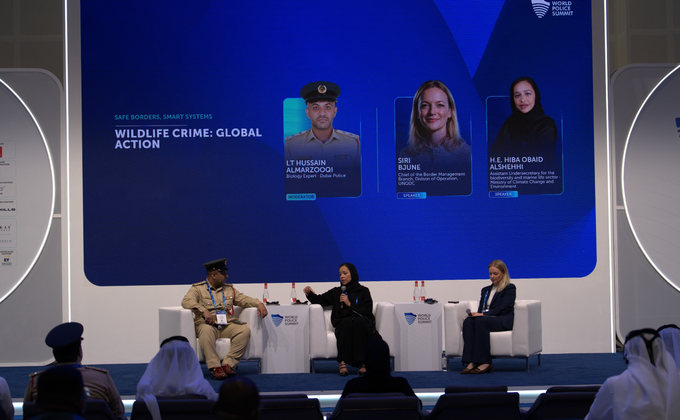
The Secure Borders and Smart Systems track addressed international cooperation against wildlife trafficking and other emerging border security threats.
During a panel titled “Wildlife Crime: Global Action,” Hiba Obaid Al Shehhi, Assistant Undersecretary for Biodiversity and Marine Life, outlined the UAE’s enforcement measures.
She said updated legislation provides penalties of up to 15 years in prison and fines reaching AED 2 million for trafficking high-value endangered species.
According to Al Shehhi, authorities have also shut down more than 600,000 websites and advertisements in cooperation with the Telecommunications and Digital Government Regulatory Authority.
Other sessions explored cross-border intelligence sharing, airport biosecurity, wildlife detection dogs, counter-drone systems, and maritime security.
Tackling cybercrime and digital fraud
The Defence Systems Against Fraud and Cyberattacks track examined emerging digital threats and cooperation between law enforcement agencies and the private sector.
Lieutenant Colonel Abdullah Mohammad Al Shehhi, Director of the Electronic and Cybercrime Department at Dubai Police, delivered a keynote on combating cybercrime.
Additional discussions addressed cyber threat intelligence, payment protection, deepfakes, synthetic identities, and cryptocurrency monitoring.
Participants emphasized coordinated responses to increasingly complex digital crimes affecting individuals, institutions, and financial systems.
Leadership and trust in policing
The Leadership at Its Core track examined the human dimension of modern policing.
Major General Dr Saleh Abdullah Murad, Assistant Commander-in-Chief for Administration Affairs at Dubai Police, highlighted the importance of trust within law enforcement institutions.
“Any police organisation can purchase drones, artificial intelligence and smart command centres, but no institution can buy or import trust,” he said.
The discussions also addressed leadership under pressure, employee well-being, and preparing future police leaders.
The summit concluded with a focus on international cooperation and the evolving role of technology in global security operations.