

When the Perimeter Spans a Continent
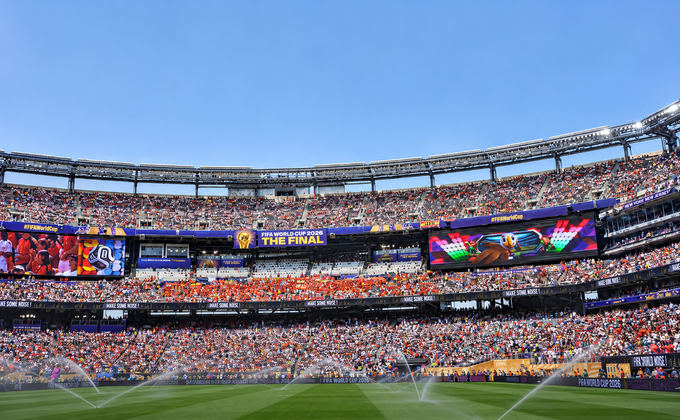
More than 6.8 million spectators, 104 matches, and 16 host cities demanded a security operation on an unprecedented scale. Its defining feature was not any single device, but the integration of access control, video surveillance, counter-drone systems, and threat intelligence into a common operating picture
By: Mirza Bahic E-mail: mirza.bahic@asmideast.com
When the largest football tournament ever staged reached its conclusion in New York/New Jersey on July 19, the security operation behind it was barely part of the story. Paradoxically, that invisibility may have been the operation’s most important result, and one of the most valuable scores of the World Cup. Does that mean things were “boring” behind the scenes of the sporting spectacle? Quite the opposite. The threats and risks were simply managed and contained in such a way that they never became the main stars of the show instead of the footballing brilliance.
The Numbers Behind the Calm
FIFA’s post-event figures included 73,700 accredited security personnel and more than one million security shifts. More than 700 unauthorized drones were seized during the US portion of the tournament. The Center for Internet Security (CIS), citing FIFA figures, also reported that more than one billion cyberattacks were blocked and over 11,000 malicious domains neutralized. Those numbers change the perspective in the sense that success did not mean that nothing happened. It meant that a vast flow of events, warnings and anomalies did not become a security crisis.
The 2026 World Cup offered an unusually tangible example of that model. The stadium was no longer the system’s only perimeter. The security environment extended to airports, rail stations, fan zones, hotels, training facilities, urban transport corridors, digital platforms and the airspace above them.
A Continent-Sized Security Zone
The tournament spanned three countries, 16 host cities and 645 official sites. Accreditation systems processed more than five million scans, while cumulative stadium attendance exceeded 6.8 million. An event with that footprint could not be managed as a series of isolated matches. Security depended on whether agencies operating under different laws, authorities and technical systems could exchange relevant information quickly enough.
Following a trilateral meeting of Canadian, Mexican and US representatives in March, UNICRI highlighted three central requirements: aligned planning, cross-border information sharing and system interoperability. Cyber threats, disinformation, supporter-related violence and drones appeared on the same risk agenda. This defined the security challenge far beyond the stadium fence: an incident in one city could have operational consequences in another, while a digital threat could develop into a physical event.
FIFA’s Tournament Operations Center (TOC) in Miami served as the central coordination point. It connected tournament leadership, host cities and more than 600 official sites, tracked incidents, distributed information and escalated risks to decision-makers. Within that environment, Lenovo developed the Intelligent Command Center (ICC), a platform that brought together data from more than 40 functional areas, including security, ticketing, infrastructure, logistics and communications. After the tournament, the company reported deploying more than 25,000 Lenovo and Motorola devices, supporting operations with over 350 engineers and specialists across more than 600 FIFA sites, and achieving 99.99 percent solution availability.
The tournament-wide view still had to be distinguished from city-level command. In Kansas City, Secure Passage converted its headquarters into a joint operations center (JOC) where local, state and federal representatives from public safety, transportation and communications worked side by side. Its Haystax platform provided a common operating picture, while its Truman platform linked the identity of center visitors with their permissions and movement through the facility. The central TOC and the local JOC formed two levels of the same architecture: one monitored the tournament as a whole, while the other concentrated on a specific city and its resources.
The Gate as the First Operational Decision
For spectators, security begins with the line outside the gate. For operators, the entrance is simultaneously a checkpoint, detection zone, flow-management problem and source of operational data. If congestion develops there, risk shifts from the stands to the crowd outside the venue. Screening speed and screening accuracy were therefore part of the same task.
ASSA ABLOY reported providing access solutions at several stadiums and delivering 1.6 million tickets, together with ticketing-system integration, entrance installations and on-site support. Axess, meanwhile, recorded nearly two million fan entries across 33 matches at five stadiums in Miami, Boston, Seattle, Vancouver and Philadelphia. At Gillette Stadium, near Boston, the company said its system handled as many as 900 spectators per minute at peak flow, with almost half the venue’s capacity entering during the 45 minutes before kickoff.
Ticket validation was only one filter. Evolv said its weapons-detection screening systems processed more than 3.5 million people at six stadiums, multiple Fan Fest sites and transit locations, including Penn Station for passengers traveling to the final. The figure describes more than technical throughput. It shows how far the event perimeter extended beyond the stadium and how security had to follow the movement of the audience rather than the limits of organizer-controlled property.
Technology did not remove the human layer. Blackbird Security deployed approximately 900 guards for each match at BC Place in Vancouver. Their duties included access control, prohibited-item searches, ticket scanning, patrols, crowd management and assistance to visitors. The deployment illustrates the limit of automation: a device can flag an anomaly, but someone still has to explain a rule, de-escalate a confrontation, assess behavior and decide when further action is necessary.
Video That Must See and Make Sense
Many stadiums had already been built up over years of NFL games, concerts and other events, so the World Cup did not start with a blank slate. Much of the security architecture was already embedded in the venues, and the tournament became its largest test. Axis Communications’ work at the final venue and Genetec’s deployment at SoFi Stadium should therefore be understood as host-venue infrastructure, not automatically as technology procured specifically for FIFA.
At what was then MetLife Stadium, renamed New York New Jersey Stadium for the tournament and host to eight matches, including the final. Axis worked with the venue’s security team on a custom camera providing a full-bowl view. A purpose-built lens delivered 8K resolution, electronic image stabilization helped preserve usable footage amid vibration and bad weather, and the device was designed to integrate with the existing VMS, other security technologies and the systems used by local public-safety agencies.
In Los Angeles, SoFi Stadium and the wider Hollywood Park campus standardized operations on Genetec Security Center. From three control rooms, operators manage more than 3,000 cameras, 700 readers, access control, automatic license plate recognition and other sensors across roughly 300 acres, or 121 hectares. The value of such a platform is not simply the number of connected devices. It is that video, alarms, identity and investigations no longer remain on separate screens and in disconnected workflows.
700 Reasons to Watch the Sky
The most visible emerging risk was also the one many spectators still regard as a toy – drones. The Federal Aviation Administration established nearly 250 temporary flight restrictions around stadiums, fan festivals, team hotels and training sites. Across the 11 US host cities, the FBI and DHS seized more than 700 drones that entered restricted airspace. Dallas alone accounted for 94: 65 near the stadium and 29 at the Fair Park Fan Fest. Those seizures formed part of the national total rather than an additional figure.
Counter-drone protection was not a single ring around a single site. D-Fend Solutions reported after the event that more than 20 law-enforcement and public-safety agencies in the United States, Canada and Mexico used EnforceAir. The system employs RF cyber takeover to assume control of an unauthorized drone when legal authority and technical conditions allow, without disrupting the wider communications spectrum.
Before the tournament, Sentrycs announced several contracts with federal, state and local organizations worth millions of dollars and said its system was expected to operate at most match venues. Its post-event account confirms support for the wider operation but does not disclose the final number of stadiums actually covered. The evidence therefore supports a confirmed deployment and its planned scale, but not a definitive claim that the system operated at most stadiums. MyDefence also said it worked with DHS on RF detection and identification around critical infrastructure, gathering areas and transport corridors, although it did not disclose the locations.
Robots in Action
Boston Dynamics’ Spot robots provided a different kind of mobile sensor. Deployed at the International Broadcast Center in Dallas and New York New Jersey Stadium, they conducted perimeter patrols for asset protection and risk detection. Findings were escalated to trained personnel for final review. That detail separates operational robotics from the promotional image of an autonomous guard: the robot extended presence and repeated a route, but it did not make the final decision.
Invisible Threats: Gases, Radiation and Sensor Silos
Some layers of protection were designed not around human behavior but around hazards invisible to the naked eye. Miami-Dade Fire Rescue deployed eight connected Blackline Safety EXO monitors at the Miami venue: four EXO 8 units capable of detecting up to eight gases and gamma radiation, and four G7 EXO units. Readings were transmitted over the cellular network to Blackline Live, allowing fire and hazmat teams to monitor conditions in real time and share data with the joint operational command.
At a broader level, Two Six Technologies deployed its SIGMA platform in multiple cities and supported security operations at more than 20 matches. The sensor-agnostic CBRNE platform brings together data for detecting chemical, biological, radiological, nuclear and explosive threats across different sensor types and manufacturers. The company said full operational capability could be established within 24 hours, including the creation of a local radiation baseline. For a temporary event spread across a continent, that portability was as important as sensor sensitivity.
The security footprint also extended to the journey. SeeTrue said its TSA-certified AI software for automated prohibited-item detection was installed in several TSA PreCheck lanes at airports serving US host cities. This was neither a stadium system nor evidence of a FIFA contract. It was an example of how passenger infrastructure absorbed tournament demand and became part of the wider security environment.
When a Digital Signal Becomes a Physical Risk
The most consequential convergence was not between two cameras, but between an online threat and a physical response. Throughout the 39-day tournament, CIS placed analysts within FIFA’s security operations and a host-city intelligence command center. They monitored threats of violence, extremist messaging, ticket fraud, fraudulent domains, swatting attempts and synthetic media, then passed relevant warnings to organizers and public agencies.
Blackbird.AI, which supported CIS, said its team produced more than 140 narrative-intelligence reports during the tournament. The number of posts or views was not the ultimate metric. The operational question was whether analysts, working amid the digital noise, could identify early enough a message that required a change in physical security, a referral to law enforcement or restraint from a public response that might amplify the disinformation.
The figures of more than one billion blocked cyberattacks and over 11,000 neutralized domains appear in post-event material from CIS and its partners, which attribute them to FIFA. Without a published methodology, they are not directly comparable with conventional incident counts and should be read as indicators of scale rather than independently audited results. The operational lesson nevertheless remains clear: cyber, reputational and physical-security teams at a mega-event can no longer work in separate streams.
What Remains After the Final Whistle?
The 2026 World Cup showed that a global tournament must accommodate different stadiums, legacy systems, local authorities and temporary technologies, rather than replace them with a single platform. A successful architecture therefore rests on agreed data, clear escalation paths and the ability for a local command center to retain its authority while sharing the relevant picture with tournament leadership.
A second lesson is that security and the visitor experience can no longer be separated. Faster entry reduces crowd buildup; better video supports both investigations and staff deployment; connected sensors speed response without shutting down an entire site. Security does not become weaker when the public barely notices it. The best system allows spectators to remember the match while the operations team knows exactly how many alerts it processed to make that possible.
Finally, technology was only as valuable as people’s ability to understand and use it. With tens of thousands of accredited security personnel, more than a million shifts and hundreds of specialists in command centers, the tournament extended human capability rather than replaced it. Sensors increased reach, platforms shortened the path from information to action, and trained operators retained responsibility for assessment and response. That may be the tournament’s most important security legacy for the 2028 Olympic Games and every mega-event that follows, one that will not be easy to surpass.