
Saudi Al-Baha region deploys 20 thermal fire detection towers
Saudi Arabia’s Al-Baha region has completed the deployment of 20 surveillance towers for early wildfire detection. The system combines thermal cameras, centralized monitoring and geographic information systems (GIS) to support faster emergency response.
According to the Saudi Press Agency (SPA), Al-Baha is the first region in the Kingdom to complete the monitoring system. All 20 towers now operate through a central hub.
The National Center for Vegetation Cover Development and Combating Desertification (NCVC) developed the project to protect forests and vegetation. The region’s governor recently inaugurated the system.
Thermal cameras support early fire detection
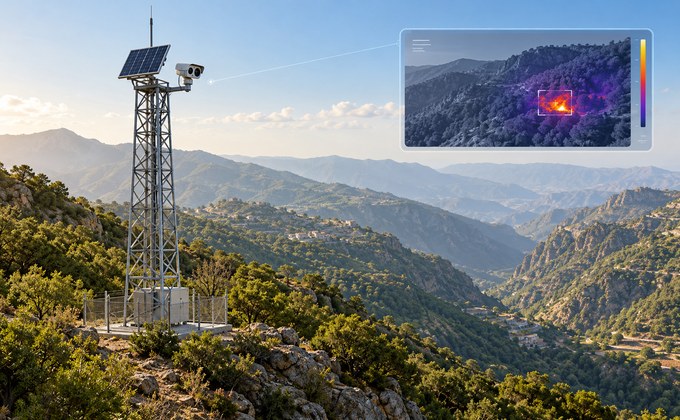
Each surveillance tower stands 20 meters high and uses solar power. The steel structures carry thermal cameras that detect smoke, heat signatures and potential fire hotspots. According to Al Riyadh, the system uses advanced dual-sensor thermal cameras. It also integrates Enterprise GIS technology to support monitoring and incident management.
The system sends real-time data to management centers. This allows operators to identify potential fire locations and make faster decisions. Mohammed Al-Zahrani, Director General of the NCVC branch in Al-Baha, said the deployment represents the first completed regional implementation.
The monitoring network forms part of Saudi Arabia’s National Forest Information Management System (NFIMS). Al Riyadh reported that the project aims to improve fire response and address environmental threats.
Saudi Arabia plans 100 surveillance towers
The Al-Baha deployment belongs to a wider initiative covering five Saudi regions. The program aims to install 100 surveillance towers and thermal cameras across Al-Baha, Aseer, Makkah, Jazan and Najran.
The initiative supports Saudi Vision 2030 and the Saudi Green Initiative. Both programs include objectives related to environmental protection and sustainable resource management. The NCVC has also pursued wider efforts to improve forest fire prevention.
In May 2025, the center completed a study on wildfire prevention and recovery in southern and southwestern Saudi Arabia. King Khalid University and Australia’s Monash University participated in the research. The study examined fire-risk areas, digital forest data and coordinated prevention measures. It also considered technologies such as drones and early warning systems.
Separately, the NCVC uses remote sensing and GIS to assess degraded vegetation in western and southern Saudi Arabia. The Al-Baha tower network adds a dedicated early detection capability to these broader forest protection efforts.