
Beyond the Server Rack: Rethinking IT Infrastructure
For organizations expanding across the Gulf, a server rack installation can quickly become a multi-discipline infrastructure project. The question is whether there is a smarter way to approach deployment from the start.
By: Kaustubh Jadhav, Regional Manager – UPS, ScreenCheck E-mail: kaustubh.jadhav@centena.com
Across the Middle East, the pace of multi-site business expansion is placing new demands on IT infrastructure. Few organizations anticipated these demands when they drew up their growth plans.
A new warehouse opens in Jebel Ali. A distribution hub is commissioned in Riyadh. A retail branch launches in Abu Dhabi. Each location begins with what appears to be a straightforward requirement: install a server rack, connect the network, get operations running.
The reality is rarely that simple. Once implementation begins, the project expands. Power availability must be assessed. Backup power factored in. The building HVAC system, designed for office occupancy rather than concentrated IT loads, may be inadequate for the server rack and its equipment. Physical security, environmental monitoring, fire protection and remote management each add further coordination requirements.
What was presented as a server rack installation has quietly become a multidisciplinary project involving IT and facilities teams, electrical contractors, HVAC specialists, and security teams, all working to different timelines. The servers are ready. The site is not.
This is the infrastructure gap that increasingly confronts distributed businesses across the region as they scale faster than their deployment processes can support.
From Rack Thinking to Environment Thinking
The shift that addresses this challenge is conceptual as much as technical. Instead of treating the server rack as the central requirement and building supporting infrastructure around it, organizations are beginning to define the complete IT environment first and deploying a solution that addresses all elements together.
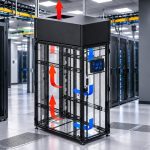
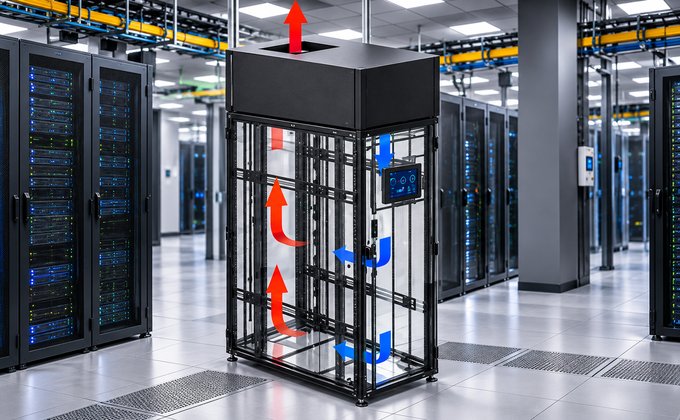
ATTOM AgileRak, an integrated Micro Data Center, represents this approach. Rather than managing power, cooling, monitoring and security as separate work streams, the infrastructure is brought together into a defined deployment.
The objective is straightforward: build the environment around the IT requirement, not the IT requirement around the available environment.
This changes the project model in a practical way. IT and facilities teams are no longer managing separate dependencies across multiple suppliers. Requirements are defined together, the solution is prepared as a whole, and deployment follows a more predictable sequence: site preparation, installation, commissioning and IT deployment.
For a retail and distribution business expanding across the Middle East, that difference is significant. A standardized infrastructure model enables a repeatable deployment methodology adaptable to different site requirements without starting from scratch each time. For the warehouse operators, branch staff and logistics teams whose daily work depends on those systems, the outcome is more reliable infrastructure from day one.
What Integration Actually Means
The technical case for integrated Micro Data Center infrastructure rests on elements that conventional server rack deployments often treat separately. Power protection and distribution form the operational foundation. At sites without dedicated server rooms or data center capacity, reliable power and protection against disruption have to be engineered into the solution rather than assumed. Dedicated cooling addresses IT equipment’s specific thermal requirements. Server loads generate concentrated heat that building HVAC systems are not designed to manage. Cooling must be sized to the IT load, not to the room.
Environmental monitoring creates the visibility that distributed operations require. Temperature, humidity, power conditions, equipment status and alarms can be monitored remotely, alerting IT teams to abnormal conditions before they become outages. Across multiple GCC sites, this visibility reduces the need to send personnel to each location for routine checks.
For businesses where every new site represents another infrastructure coordination challenge, that approach turns complexity into a scalable and repeatable process.
Physical security is frequently overlooked in distributed deployments. Server rack infrastructure installed in warehouses or regional facilities can be exposed to access risks a conventional data center would not present. Controlled access, door monitoring and integration with wider security infrastructure protect critical equipment and maintain audit visibility.
Fire protection closes the final gap, ensuring the physical environment carries the same level of risk management as the equipment it houses.
The Coordination Role
This is where ScreenCheck, as a value-added technology distributor, plays a role beyond supply. By working through a customer’s operational and technical requirements, the team helps define the solution architecture, coordinate stakeholders, and support implementation alongside the technology provider and project partners, ensuring that the infrastructure meets the intended IT requirements rather than simply confirming that equipment has been delivered.
Building a Scalable Infrastructure Model
New locations can start with the server rack infrastructure capacity they require and expand as IT and operational demands develop, aligning investment with actual business growth rather than over-provisioning from the outset.
For organizations across the UAE and the wider Gulf, the question is no longer how to install infrastructure at the next site. It is how to build an IT environment that is secure, resilient, monitored and repeatable at a pace that matches business expansion. An integrated Micro Data Center brings power, cooling, fire protection, monitoring, physical security and IT infrastructure into a single coordinated deployment model. For businesses where every new site represents another infrastructure coordination challenge, that approach turns complexity into a scalable and repeatable process.
The objective is straightforward: build the environment around the IT requirement, not the IT requirement around the available environment.