
Three Essentials in Data Center Infrastructure
Performance, availability and efficiency in IT infrastructure often seem to be a contradiction in terms. Data center availability crucially requires a secure power supply, which begins with the feed-in and distribution. Whether core, cloud, or edge, current market drivers require data center infrastructure to be smarter, more efficient, and more secure
By: Martin Kandziora, Senior Manager Marketing EMEA, Panduit GmbH
Email: Martin.Kandziora@panduit.com
A reliable power supply is a crucial element of every data center. Power supply and distribution start with the main power supply, includes the UPS as well as the sub-distribution systems which connect via the socket systems into the IT racks and directly to the IT hardware.
Depending on the design and application—whether a single-cabinet solution or a large core or cloud data center—there are different security and availability requirements. Power Distribution Units (PDUs) play an important role in a smart, efficient and secure data center infrastructure. The latest intelligent PDUs use additional sensors to collect and monitor a variety of information about the IT environment and can integrate with DCIM (data center infrastructure management) systems to provide insights into the past and current operating status of the power supply and connected equipment.
More Efficiency with Intelligence
Growing data traffic is driving the increasing power density of IT equipment installed in a cabinet. Many planners therefore design three-phase networks right into the rack in order to accommodate significantly more power in the same space compared to a single-phase solution. The energy consumption of a PDU with port-integrated measuring capabilities can be clearly assigned and controlled. Intelligent energy measurement and monitoring of the PDU provides information on:
-
Energy measurement of kilowatt hours (kWh)
-
Power measurement (W)
-
Power measurement (V, A, VA, kWh, pF) for input phases
-
Power measurement for circuit breakers
-
Exact measurement attributes for billing purposes
-
Integrated storage protocol for the recording and display of historical data including individual alarms and documentation
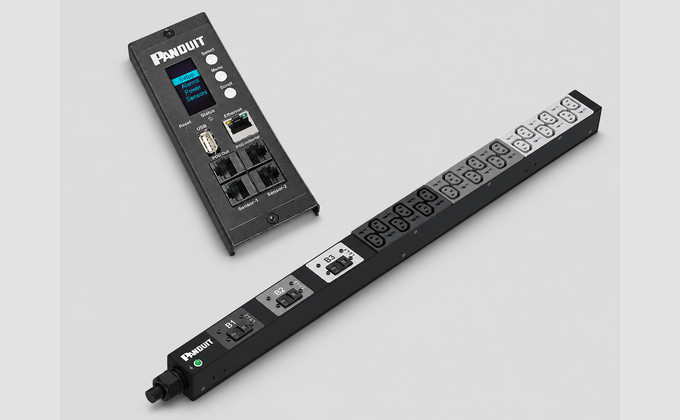
The respective OLED display of Panduit’s 5th generation iPDUs can be conveniently read on the spot. In addition, the display on 3-phase PDUs provides information about the utilization of the individual phases. Technicians can quickly and easily balance the load of the individual phases directly within the cabinet.
Some colocation applications require PDUs with energy consumption measurement (kWh) and power measurement (W) per slot. On this basis, the influence of individual components on the DCiE or PUE factor of the data center can be determined and efficiency increased. In parallel, power used can be billed to the customer with an accuracy of +/- 1%.
Future Security
Intelligent PDUs offer comprehensive capabilities for remote monitoring and in-situ control and can be integrated into operator’s DCIM systems. This allows individual slots to be switched on and off remotely and the reboot delay after a power failure to be configured sequentially for individual IT devices. This prevents overloads due to high inrush currents.
Intelligent PDUs offer comprehensive capabilities for remote monitoring and in-situ control and can be integrated into operators DCIM systems
Individually assignable user profiles and access authorizations additionally increase system security. Today’s PDU has taken on a completely new role as an important feature of the security of the IT infrastructure.
iPDU’s access security is achieved through SNMPv3, RESTful API and TLS as well as certificate-based, asymmetric encryption, which is monitored and strengthened with several security check tools. This is supported with various complex passwords and modern authorization options – locally, via LDAP and via Active Directory.
The intelligent PDU implements comprehensive network management and alarm functions with support for HTTP, HTTPS, SSH, Telnet, SNMP, FTP and e-mail. A redundant 1G network access in 2N configuration provides network redundancy and is suitable for colocation applications. Both the colo operator and the customer can access the same PDU data with their respective networks running completely independently and, depending on the level of authorization, monitor or control the power supply to the consumer’s equipment.
Authorized access secures sensitive data and systems of the data center or micro-data center from incorrect or criminal access. The iPDUs support environment and security management with optional plug-and-play environmental sensors, e.g. for temperature, humidity, potential-free contact and leakage. The sensors can be integrated into the infrastructure either by cable or, soon, wirelessly.
For physical security management within the data center, the intelligent PDUs monitor rack access with door contact switches and potential-free contacts that can, for example, control signal lights or air conditioning.
Smart Mechanics and Intelligence
Today’s iPDUs offer high density solutions with clever slot configurations. Output cables fit into almost any rack size at the top, bottom or front to minimize cable congestion and the flat construction of the modular iPDU design saves space in the rack.
The network module can be exchanged quickly and easily using the hot-swap method. All socket modules of the intelligent PDU from Panduit form a self-contained system and are protected against accidental contact. This allows the PDU to be used even without electrical expertise. The PDU can be quickly installed by simply hooking it in, which reduces assembly time as well as cost and logistics effort.
A further benefit is that, under full load, the PDU can withstand temperatures of up to 60 °C and can therefore also be used in high-performance environments.
Conclusion
In view of the increasing energy costs and required power densities, intelligent PDUs are gaining in importance. In networked and distributed IT infrastructures, the demand for remote monitoring and remote control is growing.
In addition, modular and network-compatible power distribution systems significantly increase flexibility and scalability. Integrated measuring functions of the PDU optimize energy consumption and reduce overall energy consumption.
At the same time, the integral sensor technology leads to better infrastructure monitoring and, together with the cybersecurity functions, to more secure systems overall.
The bottom line: the intelligent PDU in future data center infrastructures will be smarter, more efficient and safer.