

Surveillance leads $54.65bn border security market
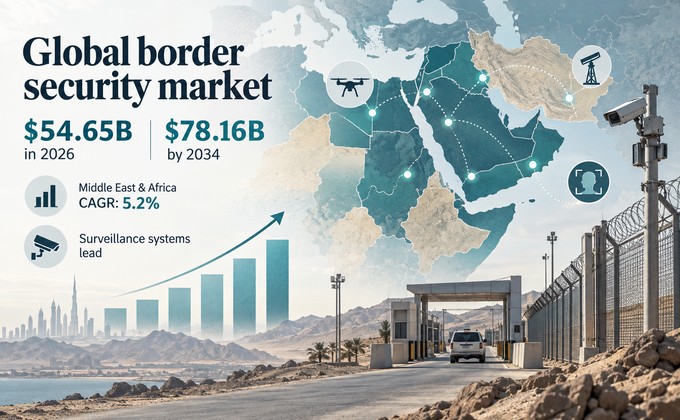
The global border security market is expected to reach $54.65 billion in 2026, while the Middle East and Africa segment is forecast to grow at a 5.2% CAGR.
Surveillance systems remain the largest technology segment, as governments increase investment in AI, biometrics, drones, and integrated border protection systems. According to a new Polaris Market Research report, the global market is projected to reach $78.16 billion by 2034.
Surveillance systems take largest share
Surveillance systems accounted for 25.9% of the border security market in 2025. Polaris links their leading position to demand for advanced monitoring solutions and growing investment in AI, machine learning threat detection, and high-resolution imaging.
The report also points to greater integration with biometric identification and access control systems. Land border security represented 52.8% of the market in 2025. New installations accounted for 58.1%, supported by government spending on new surveillance and monitoring infrastructure.
BORDER SECURITY MARKET
$54.65 billion estimated market size in 2026
$78.16 billion projected by 2034
25.9% surveillance systems share in 2025
58.1% share held by new installations in 2025
AI, biometrics and drones gain ground
Governments are increasing investment in technologies such as surveillance drones, biometric identification, and AI-powered analytics. Polaris says AI can help agencies process surveillance data, detect unusual activity, and respond faster to potential threats.
Drones are also becoming more important for monitoring remote areas where fixed infrastructure may be difficult to deploy. Biometric systems are increasingly used for identity verification at border crossings and airports.
Middle East market set for further growth
The Middle East and Africa border security market is projected to grow at a CAGR of 5.2%. Polaris links regional growth to concerns over cross-border crime, irregular migration, and wider security risks. Governments are also increasing investment in land and maritime surveillance systems.
The report specifically highlights Saudi Arabia and the UAE among countries investing heavily in advanced security systems. Demand is also being supported by efforts to protect critical infrastructure.
New systems reshape border protection
Polaris expects smart border infrastructure to create further opportunities for security technology providers. Future systems are expected to combine AI, sensor networks, automated monitoring, biometrics, unmanned systems, and cybersecurity. The report also points to continued modernization of existing border infrastructure as agencies seek faster detection and more integrated operations.