
Building a Trusted Identity for the Modern Enterprise
As physical security moves beyond cards, PINs, and passwords, Iris ID is combining iris and facial recognition with centralized identity management to strengthen verification, support existing access-control infrastructure, and give organizations greater confidence in who is entering their facilities
By: Mohammed Murad, Chief Revenue Officer, Iris ID
E-mail: mohammed.murad@irisid.com
The way we think about security has changed considerably over the years. Yet many organizations still rely on the same familiar methods to control access to their facilities: cards, PINs, and passwords. These technologies have served us well, but they have one fundamental weakness. They verify a credential, not necessarily the person using it. Cards get misplaced, passwords are shared, and credentials can fall into the wrong hands.
This is becoming an increasingly important issue in the Middle East, where governments and businesses are making substantial investments in infrastructure, digital transformation, and national security. Whether it’s a government ministry, an airport, a data center, or an energy facility, the question is essentially the same: How can we be certain that the person requesting access is who they claim to be? At Iris ID, we have spent more than 25 years working to answer that question. Our approach is developed around the simple idea of One Trusted Identity.
Bringing Two Biometrics Together
Iris recognition has long been recognized for its exceptional accuracy. Facial recognition, meanwhile, offers convenience and familiarity. Both have strengths, but we believe there is a real advantage in bringing them together.
That’s the thinking behind our IrisAccess® iA1000.
Rather than depending on a single biometric characteristic, the iA1000 combines dual iris recognition and facial recognition in one contactless device. By combining these technologies together through biometric fusion, we can provide a higher level of confidence in identity verification without making the experience more complicated for the user.
Of course, accuracy is only part of the challenge. With advances in artificial intelligence, the industry is facing increasingly sophisticated attempts to deceive biometric systems. That’s why the iA1000 incorporates Presentation Attack Detection (PAD), adding another layer of protection against manipulated or artificial biometric presentations.
We also paid a lot of attention to user experience. The device features automatic optical adjustment and a circular display that helps guide people through the authentication experience. There is no need to touch the device, and the process is designed to be fast and simple.
Additionally, the iA1000 supports smart cards, PIN authentication, PoE, OSDP, and Wiegand connectivity. Customers can introduce stronger biometric security while continuing to work with much of their existing access control infrastructure.
Managing Identity Across the Enterprise
Over the years, we have learned that installing a biometric device is often the easy part. Managing thousands of users across multiple buildings, locations, and countries is where things become more complicated. A large organization needs to know who has access, where access is permitted, and how security policies are applied. Doing this through separate systems at every facility quickly becomes difficult to manage. This is why we developed the IrisAccess Management Suite (iAMS).
iAMS brings biometric identity management, device administration, access permissions, and security activity into a centralized, web-enabled environment. Administrators can manage users, monitor devices, review transactions, and apply consistent policies across their organization. Through REST APIs, the platform can also integrate with existing physical access control systems, human resources applications, and other enterprise software.
Another important consideration is protecting the investments customers have already made. Many organizations have relied on IrisAccess technology for years, and replacing an entire installation overnight is simply not practical. With our migration tools, customers can move gradually from earlier generations of IrisAccess to the iA1000 and iAMS, taking advantage of new capabilities without having to start from scratch.
Experience That Matters
The Middle East has been an important part of Iris ID’s business for many years. We have worked with customers in government, aviation, immigration, and critical infrastructure, where security requirements are demanding, and reliability is critical. We learned from these deployments that customers want technology that fits into their existing operations, works with other enterprise systems, and can grow as their security requirements change. This is especially relevant in the region, where countries such as Saudi Arabia, the UAE, and Qatar continue to invest in new infrastructure and the modernization of existing facilities.
Security Must Work in the Real World
After many years in the biometric industry, one lesson stands out: technology must work in the customer’s environment, not the other way around. Consider a government data center, where security policies may require devices with tightly controlled software environments. The iA1000 addresses this through a closed Linux-based architecture that prevents unauthorized application installation while allowing integration through defined interfaces.
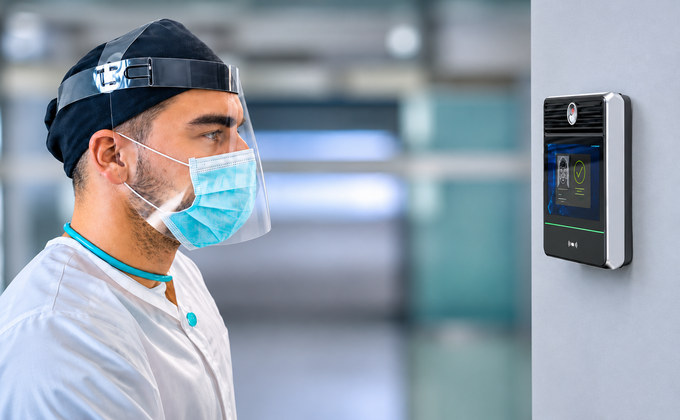
Now consider a cleanroom or laboratory. Employees may be wearing masks, gowns, or other protective equipment. Traditional facial recognition can become difficult in these conditions, while iris recognition can remain effective as long as the eyes are sufficiently visible. Even within the same organization, security requirements can vary considerably. A general office entrance may need a simple authentication process, while access to a sensitive control room may call for combined iris-and-face verification. Our goal is to give customers flexibility without making everyday access unnecessarily difficult.
One Trusted Identity
I believe the next major step in physical security will be more about how organizations establish and manage trusted identities. Better cameras and faster processors will certainly help. But what really matters is having confidence that the person entering a facility is authorized to be there and being able to maintain that confidence consistently across an entire organization. As countries across the Middle East continue developing smart cities, digital services, and critical infrastructure, the importance of reliable identity verification will only increase.
At Iris ID, we are building on more than 25 years of iris recognition experience to address these changing needs. The combination of iA1000 and iAMS brings together multimodal biometric fusion authentication, centralized management, and the flexibility to integrate with existing enterprise systems.
For us, the objective has always been straightforward. We want to help customers move beyond simply checking a credential and toward knowing, with confidence, who is standing at the door.